
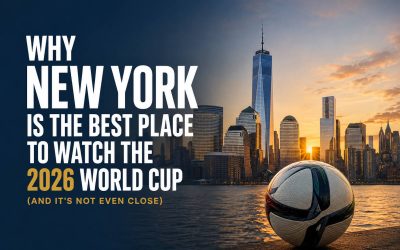
Let’s be honest. You could watch the 2026 FIFA World Cup from Dallas. You could watch it from Seattle. You could even watch it from a beach bar in Cancún with sand between your toes and a margarita sweating in your hand.
But you’re not reading this because you want “fine.”
You’re reading this because you want electric. You want to feel the tournament in your chest — in the streets, in the bars, in the packed subway cars at 6am where strangers from six different countries are all wearing their colors and screaming about a goal that just went in on the other side of the world.
For that? There is only one city. And that city is New York.
The Final Is Here. Full Stop.
Let’s start with the single most undeniable fact in the entire debate.
On July 19, 2026, the FIFA World Cup Final will be played at MetLife Stadium — just eight miles west of Midtown Manhattan. Not in Los Angeles. Not in Miami. Not in any other city wearing a “Global Event” badge.
New York.
MetLife Stadium — rebranded as New York New Jersey Stadium for the tournament — will host eight matches in total: five group stage games, a Round of 32, a Round of 16, and then the grandest match in all of football. By the time the trophy goes up, the New York region will have hosted more World Cup history than almost anywhere else on the planet.
If you’re the kind of fan who wants to say “I was there when the world came to play,” the answer is simple: be here.
The City That IS the World
Here’s something that no other host city can claim: New York doesn’t just welcome the world during the tournament. New York already IS the world.
Queens alone is considered the most ethnically and culturally diverse urban area on Earth — with over 135 languages spoken by residents representing more than 120 countries. Think about what that means when the World Cup arrives.
When Ecuador plays Germany at MetLife on June 25, Jackson Heights in Queens doesn’t just watch the match — it becomes the match. The restaurants, the flags, the noise, the absolute chaos of celebration spilling into the streets: it’s the closest thing to actually being in the stadium short of buying a ticket.
Head to Astoria when Morocco or Greece plays. Find Bay Ridge when Norway is on. Hit up Harlem when Senegal takes the pitch. In New York, every match has a neighborhood — a community of real fans for whom this tournament isn’t tourism, it’s personal. The kind of atmosphere you simply cannot manufacture anywhere else.
Five Boroughs. All Free. All World Cup.
You don’t need a match ticket to live inside this tournament.
New York City is rolling out free official fan zones in all five boroughs — Brooklyn, Queens, The Bronx, Manhattan, and Staten Island — running from June 13 through July 19. Giant screens. Live match broadcasts. Local food vendors. Cultural programming. No entry fee.
Here’s what each borough brings to the table:
Brooklyn Bridge Park (Dumbo) runs the full tournament, with match viewings against one of the most iconic skylines in the world. Watching football with the Manhattan Bridge behind you is genuinely something else.
Louis Armstrong Stadium, Queens — the Fan Zone Queens — is the official FIFA-branded festival hub for the borough the world calls home. Expect the most diverse, most passionate, loudest crowd of any free event in the city.
The Bronx Terminal Market (near Yankee Stadium) brings family-friendly programming rooted in the borough’s vibrant Latin communities. The Bronx invented the block party, and this will feel like the greatest one in history.
Rockefeller Center transforms into a global watch party from July 4 through the final, putting football at the literal center of Manhattan.
And then there’s the one that will make your jaw drop: for the World Cup Final itself, 50,000 fans will gather on Central Park’s Great Lawn for one of the largest free watch parties anywhere on Earth, presented by Global Citizen.
Fifty thousand people. Central Park. The World Cup Final.
Let that sink in.
The Soccer Bar Culture Is Unmatched
New York’s soccer bar scene isn’t something that came together for this tournament. It’s been here for decades, built by generations of immigrant communities who refused to give up the game they loved.
These are bars that open at 6am for Premier League fixtures. That turn off the lights and project Champions League matches like they’re screening a film. That have the flags of 40 nations hanging from the ceiling because their regulars come from 40 nations.
For the World Cup, they’re running at full power:
Banter in Williamsburg is Brooklyn’s undisputed soccer temple — a long bar that fills to the walls with an international crowd that treats every match like a final. For a neighborhood-feel watch party with genuine soccer soul, this is your destination.
Bohemian Hall & Beer Garden in Astoria has been a community anchor since 1910. During the summer, the vast outdoor space fills with communal tables under string lights — all tuned to the World Cup. If you want to watch football outdoors in New York with a cold beer and the buzz of the city around you, this is it.
The Red Lion on Bleecker Street in the West Village is Downtown Manhattan’s home for football, 10+ HD screens, full kitchen all day, open early for every fixture. The Red Lion doesn’t decorate itself as a soccer bar for events — it is a soccer bar, always, and the World Cup is simply its Super Bowl.
In Hell’s Kitchen, the East Village, Midtown — you will never be more than a few blocks from a packed bar, a big screen, and the kind of strangers who become friends inside 90 minutes of football.
Getting There Is Easy. Actually Easy.
Here’s where New York quietly dominates every logistical comparison with other host cities.
MetLife Stadium is connected to Manhattan by NJ Transit — a train from Penn Station to Secaucus Junction, then a Meadowlands Rail shuttle on event days, dropping you steps from the stadium gate. On non-match days, the entire city’s subway, bus, PATH, ferry, and commuter rail network means you can get from your hotel in any borough to any fan zone without a car, a taxi, or a headache.
For a tournament spanning six weeks across a region of 20 million people, that kind of mobility is everything. No rental cars. No parking. Just the city working the way great cities work.
The City Never Sleeps — And Neither Will You
Between matches, New York doesn’t ask you to fill your time. It dares you to keep up.
Michelin-starred restaurants where you can eat from any cuisine on the planet. Broadway. The High Line at golden hour. Rooftop bars above the skyline. Jazz at the Village Vanguard. A slice at 3am because you can. World-class museums. Shopping. Art. Music. The sheer kinetic energy of eight million people living their lives at full volume around you.
No other host city offers a cultural backdrop like this. When the final whistle blows and you’re trying to figure out what to do with yourself, New York has approximately ten thousand answers waiting.
This Is a Once-in-a-Lifetime Convergence
The World Cup comes around every four years. A tournament this size, in this format — 48 teams, 104 matches, three countries, the whole world watching — has never happened before. And when the last match of that tournament, the one that determines the world champion, is played just eight miles from Times Square, that’s not a coincidence you can recreate.
There will be great fan experiences in Dallas. In Los Angeles. In Toronto and Guadalajara and Kansas City.
But the Final is in New York. The greatest free watch party on earth is in New York. The most diverse fan communities on the planet are in New York. The deepest soccer bar culture in North America is in New York.
If you’re going to be anywhere for the 2026 FIFA World Cup, be here.
Planning your World Cup trip to New York? Check our full NYC fan guide — stadium access, hotel tips, fan zones by borough, and the best bars for your team’s supporters


 FIFA World Cup 2026 Complete Group Stage Guide: All 12 Groups, Key Fixtures, Predictions and How to Watch
Leave a Reply