
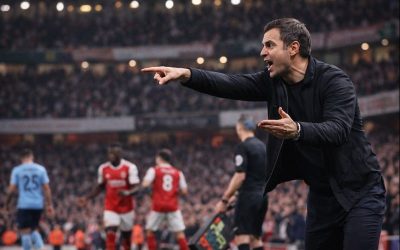
Matches are often described as if they unfold entirely within the white lines. As if the contest is settled by formations, duels, and moments of execution alone. But look beyond the ball and you’ll find another layer of the game unfolding in parallel — a constant stream of observation, recalibration, and quiet intervention coming from the technical area.
The modern manager is no longer a distant figure waiting for halftime. He is embedded in the match itself, shaping its rhythm, nudging its direction, and, at times, redirecting its outcome from a few metres away.
Why in-game leadership has taken on new importance
Football’s evolution has reduced the value of static planning. Opponents prepare more thoroughly, players process information faster, and tactical surprises are increasingly rare. What remains unpredictable is how a match breathes — when it tightens, loosens, or begins to tilt.
That is where touchline influence now carries weight.
Coaches are expected to interpret unfolding patterns in real time: a midfield losing duels, a press arriving half a second late, a winger pinned too deep to offer threat. These aren’t problems for tomorrow’s training session. They are issues to be addressed before they become irreversible.
In tournaments and knockout settings, where margins are unforgiving, the ability to intervene early — and correctly — often separates progress from elimination.
What managers actually change during matches
Influence from the sidelines is rarely theatrical. It is functional.
A coach may instruct a striker to screen a passing lane rather than chase the ball. He might ask a centre-back to carry possession instead of releasing early. Full-backs are told when to hold width and when to narrow, not as a wholesale shift but as a situational adjustment.
Substitutions, too, are increasingly strategic rather than reactive. A change might be designed to alter spacing rather than personnel — introducing a midfielder who can occupy pockets, or a forward whose movement disrupts a specific defender. With expanded substitution allowances, managers can now reshape matches in stages rather than single gambles.
Even time management is part of the craft. Knowing when to slow the game, when to accelerate restarts, or when to let play run reflects an understanding of momentum that goes beyond tactics.
Communication and trust under pressure
Instruction only works if it lands.
The most effective managers communicate economically. During matches, clarity matters more than complexity. Short cues replace long explanations. Repetition replaces elaboration. Players are not being taught; they are being reminded.
Emotional intelligence plays a role here. Some teams require reassurance when control slips. Others need provocation to regain edge. Managers adjust their tone accordingly, aware that anxiety spreads faster than instruction.
Leadership groups within squads act as extensions of the touchline. A shouted message rarely reaches eleven players at once. It travels through captains and senior figures, filtered and applied in real time.
Where touchline influence ends
There are limits to sideline control, and the best coaches understand them.
Football remains chaotic by nature. No amount of gesturing can account for a miscontrolled pass or a deflected shot. Over-intervention can create doubt, slowing decision-making rather than sharpening it.
Some matches are best managed by restraint. Allowing players to solve problems themselves can preserve rhythm and confidence. In these moments, the absence of visible instruction is itself a deliberate choice.
Touchline influence is not about domination. It is about timing.
What this means for the future of the game
As football heads toward World Cup 2026, the demands on managers will intensify. Longer stoppage times, deeper benches, and tighter schedules will stretch matches into unfamiliar shapes. The ability to manage energy, psychology, and structure within games will matter as much as pre-tournament planning.
Success will belong to those who can see shifts before they announce themselves — and respond without overcorrecting.
The most important decisions in modern football are not always made with a whistle or a kick. Increasingly, they arrive through a glance, a signal, or a well-timed word from the edge of the pitch — subtle interventions that quietly steer matches toward their conclusion.


 Why Late Goals Are Becoming More Common
Leave a Reply