
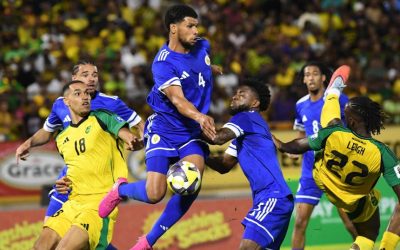
WILLEMSTAD, CURAÇAO — In the southern Caribbean, on an island smaller than the city of New Orleans, a siren pierced the midnight air on November 18. It wasn’t an emergency warning—it was the sound of history being made.
Curaçao, a nation with an estimated population of just 185,000, has officially qualified for the FIFA World Cup 2026, becoming the smallest country by population ever to reach football’s global finals. The achievement eclipses the previous record held by Iceland (population 350,000) and cements Curaçao’s place in World Cup history.
The milestone was secured with a heroic 0–0 draw against regional powerhouse Jamaica in Kingston, a result that sent shockwaves through international football and ignited celebrations across the Caribbean island.
Related: Big Nations Under Pressure in World Cup 2026 Qualifiers
The Stoppage-Time Drama That Defined a Nation
Curaçao’s road to the World Cup was not just a sporting success—it was a gripping football drama.
Entering the final qualifying window, the national team—known as the “Blue Wave”—remained unbeaten across ten matches. But everything nearly unraveled in the final moments at Independence Park, Kingston.
In the fourth minute of stoppage time, the referee awarded Jamaica a penalty. The stadium erupted. Curaçaoan players dropped to the turf in disbelief. Their World Cup dream hung on a single kick.
Then came the twist.
After a tense VAR review, the decision was overturned. No penalty. No heartbreak. Just disbelief, relief, and jubilation. In Willemstad, celebrations spilled into the streets as church bells rang, car horns blared, and fireworks lit up the harbor. The miracle was real.
Qualifying Without the Head Coach: Leadership Under Pressure
Remarkably, Curaçao achieved this historic qualification without their head coach on the touchline.
Veteran manager Dick Advocaat, one of Europe’s most respected football minds, had been forced to return to the Netherlands days earlier due to urgent family matters. Responsibility fell to his trusted assistant, Cor Pot.
Under Pot’s calm leadership, the players held their composure during the agonizing final minutes. It was a masterclass in mental strength—proof that Curaçao’s rise is built not just on talent, but professionalism.
A Decade in the Making: Curaçao’s Dutch Diaspora Strategy
While headlines credit the recent “Advocaat Revolution,” Curaçao’s World Cup qualification is the result of a long-term football strategy more than a decade in the making.
The foundations were laid in 2015 under Patrick Kluivert, then strengthened by Guus Hiddink, who developed an advanced recruitment pipeline tapping into the Dutch-Curaçaoan diaspora.
Advocaat and Pot later refined this structure, uniting Europe-based professionals such as Tahith Chong (Sheffield United) and Juninho Bacuna (Al-Wahda) with homegrown players. By convincing Eredivisie and English-league talents to represent the Blue Wave, Curaçao transformed from a regional outsider into a disciplined international force.
World Cup 2026 Group E: A David vs. Goliath Challenge
The reward for this historic qualification is the ultimate test on football’s biggest stage.
The FIFA World Cup 2026 draw placed Curaçao in Group E, setting up one of the most striking mismatches in tournament history.
-
June 14, 2026 – Houston (NRG Stadium): Germany vs. Curaçao
-
June 20, 2026 – Kansas City: Curaçao vs. Ecuador
-
June 25, 2026 – Philadelphia: Curaçao vs. Ivory Coast
Facing a top-10 German side stacked with Bundesliga stars, Curaçao’s squad—largely composed of players from the English lower leagues and Dutch second tier—will enter as heavy underdogs. Yet their qualification alone has already rewritten football’s limits.
More Than Football: A Nation Seen by the World
For a country spanning just 444 square kilometers, this moment transcends sport.
As fans filled the historic districts of Punda and Otrobanda, waving blue-and-yellow flags late into the night, one supporter summed it up perfectly:
“Most people can’t find us on a map. On June 14, the whole world will have to look.”
Curaçao may be the smallest nation ever to qualify for the FIFA World Cup—but in ambition, belief, and resilience, the Blue Wave now stands shoulder to shoulder with the giants of the game.
The world is watching. And Curaçao has arrived.


 2026 World Cup: How FIFA’s New Rules Could Change Football Forever
Leave a Reply