
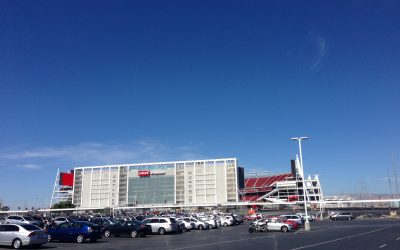
Levi’s Stadium sits in Santa Clara, not San Francisco, a detail that trips up plenty of visitors planning their World Cup trip. It’s roughly 45 miles south of the city, deep in Silicon Valley, and the freeways that serve it, US-101 and CA-237, are already among the most congested commuter corridors in the country on a normal weekday afternoon. Layer six World Cup matches on top of that, plus standard 49ers-style stadium parking pricing, and the math tips hard toward transit.
On-Site Parking: Plentiful, But Not Cheap
Levi’s Stadium has extensive surface and garage parking built for NFL Sundays, and for the World Cup it’s being sold through a prepaid pass system rather than pay-on-arrival, mirroring how 49ers games already work. Passes are tiered by lot proximity, with the closest lots commanding premium prices similar to or above standard NFL parking, which already runs $40 to $80 depending on the game. Stadium operators have also been clear that lots open several hours before kickoff and that gates lock down access tightly once full, so arriving without a prepaid pass in hand is a real risk of getting turned away entirely.
The Train That Was Built For This Exact Stadium
Levi’s Stadium has its own dedicated train platform, served by both ACE (Altamont Corridor Express) and Capitol Corridor trains, which run special event service timed to match start and end times. This isn’t a generic regional rail stop; it was designed specifically to move stadium crowds, with trains pulling in from the East Bay, the Central Valley, and Sacramento corridor stations. VTA light rail also serves the stadium via the Tasman line, connecting to the broader South Bay network and to Caltrain at Mountain View and other stops.
Why Driving the 101 Is the Riskier Bet
Match-day traffic studies around Levi’s Stadium have consistently shown the 101/237 interchange backing up for miles before kickoff and after the final whistle, and World Cup crowds will be larger and less predictable than a typical 49ers Sunday. Local and event organizers have repeatedly pointed fans toward the special-event trains specifically because road capacity into Santa Clara doesn’t scale the way rail does.
The Bottom Line
A stadium literally built with its own train platform is about as strong a hint as a venue can give. Skip the prepaid parking gamble and the 101 backup, and let the ACE or Capitol Corridor special trains do the heavy lifting on match day.


Leave a Reply