
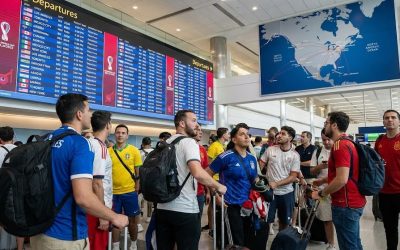
Football has always been a game of movement. Players drift between lines, teams cross borders, and supporters follow — sometimes across continents — chasing moments that feel bigger than the journey itself. World Cup 2026 will test that relationship between football and travel in ways no tournament has before. Not because fans care less about being there, but because getting there — and moving once they arrive — will shape the experience as much as the matches themselves.
This matters now because the World Cup is no longer a single destination. It is becoming a network.
Related: World Cup 2026 Explained: Teams, Format, Host Cities & What’s New
The bigger picture: a tournament spread across distance
World Cups have always required commitment from travelling fans, but 2026 introduces a different scale. With matches spread across the United States, Canada, and Mexico, the tournament geography is unprecedented. In previous editions, even large host nations allowed fans to build a sense of place — moving by train, car, or short flights while staying anchored to one cultural environment.
In 2026, the tournament footprint stretches thousands of kilometres. A group-stage match in the American Midwest may be followed by a knockout game on the Pacific coast. For fans, that changes not just logistics, but rhythm. The World Cup becomes less of a continuous pilgrimage and more of a series of deliberate choices.
Related: Why World Cup 2026 Could Produce More Upsets Than Ever
This shift mirrors broader trends in global football. Club competitions have expanded across regions, pre-season tours crisscross continents, and supporters increasingly engage with football as a global, mobile product. The World Cup is now reflecting that reality rather than resisting it.
How fan travel will actually work
The mechanics of fan travel in 2026 will reward planning over spontaneity. Travel clusters — where teams play multiple matches in the same region — will become central to the fan experience. Supporters who base themselves around one host city or region may see fewer matches, but enjoy a more coherent journey.
For others, the World Cup will be modular. Fans may attend only a handful of games, choosing key fixtures rather than following a team everywhere. This is not necessarily a loss. It reflects how modern supporters already engage with football, balancing time, cost, and access.
Infrastructure plays a decisive role. North America’s reliance on air travel contrasts with past tournaments built around rail networks. That reality reduces the romantic image of fans moving en masse between cities, but it also introduces new forms of community — watch parties, fan hubs, and localized matchday cultures that exist alongside stadium attendance.
Related: FIFA to Increase Prize Money by 50% for World Cup 2026
The human element: who gets to travel, and how
Travel has always been part of the World Cup’s mythology, but it has never been equally accessible. World Cup 2026 will amplify that tension. Costs, visas, and distances will inevitably shape who can attend in person.
For many fans, especially from outside North America, travel will be selective. A single match, or a short stay, may replace the traditional idea of following a team through the tournament. For local and regional supporters, however, the World Cup becomes more reachable, with matches arriving closer to home than ever before.
This creates overlapping Worlds Cups — one experienced through travel, another through proximity, and a third through screens. None is more “authentic” than the others, but they will feel different.
Balance and nuance: loss of intimacy, gain of scale
There is a legitimate concern that distance dilutes atmosphere. Smaller, tightly packed tournaments create accidental encounters — fans sharing trains, streets, and routines. A sprawling World Cup risks fragmenting that shared experience.
At the same time, scale brings opportunity. More cities mean more local cultures shaping the tournament. More fans experience the World Cup not as visitors, but as hosts. The event becomes less centralized, but arguably more representative of global football’s reach.
The trade-off is between intimacy and inclusivity — a balance FIFA has consciously chosen to test.
Looking ahead: redefining what it means to “be there”
World Cup 2026 will not redefine fandom, but it will clarify something important: being present no longer requires total immersion. Fans will experience the tournament in segments — geographically, emotionally, and temporally.
Future World Cups may follow this model, especially as football continues to expand into new markets. Travel will remain central to the mythology of the game, but its meaning will evolve. The World Cup experience will be shaped less by how far fans go, and more by how intentionally they choose to engage.
The game, after all, has always adapted to movement. Its supporters are simply learning to do the same.


 FIFA to Increase Prize Money by 50% for World Cup 2026
Leave a Reply