
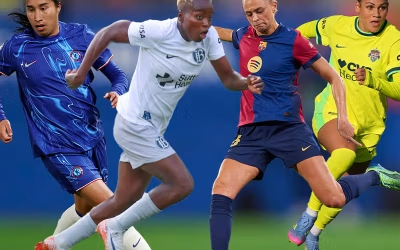
If football feels different now, it’s because it is. Not louder. Not flashier. Fundamentally different.
Matches are played at a pace that would have looked unsustainable a decade ago. Players cover more ground, make decisions earlier, and execute under pressure that arrives in waves. Coaches speak in the language of zones and triggers. Analysts dissect games frame by frame. Even casual fans can sense it: the game has accelerated—and sharpened—at every level.
This isn’t evolution by fashion. It’s football responding to forces that have quietly reshaped how the sport is trained, taught, and played.
Related: How Tactics Really Win Titles in Elite Football
Speed Isn’t Just Physical Anymore
The most obvious change is tempo. Presses are coordinated. Transitions are ruthless. Time on the ball has evaporated.
But the real acceleration isn’t in legs—it’s in minds.
Modern footballers scan more often, process faster, and act earlier. A pass that arrives half a second late is now intercepted. A decision delayed by a touch becomes a turnover. The game has punished hesitation out of existence.
This is why raw pace alone no longer separates players. Speed of thought does.
Pressing Became a System, Not a Personality
Pressing used to be described as “work rate.” Now it’s geometry.
Teams press in units, not individuals. Triggers are agreed upon: a backward pass, a poor first touch, a sideline trap. The goal isn’t to win the ball immediately, but to corral the opponent into predictable mistakes.
When it works, football looks frantic. When it fails, it looks reckless. The difference is preparation.
Modern football rewards teams that can press aggressively and retreat intelligently—often within the same passage of play.
Space Is the Real Currency
The biggest tactical shift of the modern era is how teams manipulate space—especially without the ball.
Defensive blocks are compact, vertical distances are reduced, and passing lanes are squeezed. Attacks respond by stretching the pitch horizontally, inverting fullbacks, or using false movements to disorganize shape.
What looks like chaos is often choreography.
Goals today are rarely accidents. They are manufactured through positional advantages created two or three actions earlier.
Data Didn’t Replace Instinct—It Refined It
Football did not become robotic. It became informed.
Data now supports decisions that were once intuitive: when to press, where to shoot from, how to defend set pieces, when to rotate squads. Coaches don’t outsource judgment to numbers—they sharpen it.
The result is fewer wasted actions. Less speculative play. More efficiency.
Modern football is not less creative. It is more selective about where creativity is applied.
Roles Have Blurred—Responsibility Hasn’t
Positions still exist. They just don’t behave as rigidly.
Fullbacks become midfielders. Wingers defend inside. Strikers initiate presses instead of waiting for service. The modern game demands multi-functional players who understand the game as a network, not a map.
Yet for all this fluidity, responsibility has intensified. Every player is accountable in every phase. There are fewer places to hide.
That’s why footballers are coached to understand systems, not just roles.
Coaching Became a Competitive Edge
The tactical gap between elite teams and the rest has narrowed—not because the elite regressed, but because coaching improved everywhere.
Smaller clubs now arrive with clear game plans, tailored pressing schemes, and opponent-specific strategies. Preparation levels that were once exclusive are now standard.
This has raised the collective IQ of the sport.
Modern football is harder to dominate because opponents arrive organized, informed, and unafraid.
Matches Are Won Before They’re Played
Preparation now extends far beyond training pitches.
Video analysis, opposition profiling, load management, and recovery planning shape outcomes long before kickoff. Coaches plan for phases within matches—when to suffer, when to surge, when to slow the game down.
This doesn’t remove spontaneity. It frames it.
When a player produces a moment of brilliance today, it often emerges from a context deliberately constructed to allow it.
Why the Game Feels Relentless
Put it all together and the effect is unmistakable.
Modern football:
-
Compresses time
-
Punishes mistakes instantly
-
Rewards intelligence as much as athleticism
-
Demands total participation
Matches rarely breathe. Control is temporary. Momentum swings faster.
For viewers, it feels intense. For players, it’s exhausting. For coaches, it’s unforgiving.
And that is precisely why it’s compelling.
The Evolution Isn’t Finished
Football will keep changing because its margins keep shrinking.
As players get faster, tactics get smarter. As tactics get smarter, preparation gets deeper. As preparation deepens, innovation becomes the only advantage left.
The game didn’t become faster, smarter, and more tactical by choice.
It did so because survival at the top demanded it.
And the next evolution is already underway—quietly, relentlessly—one adjustment at a time.


 From Wonderkid to Superstar: How Football Careers Are Really Built
Leave a Reply